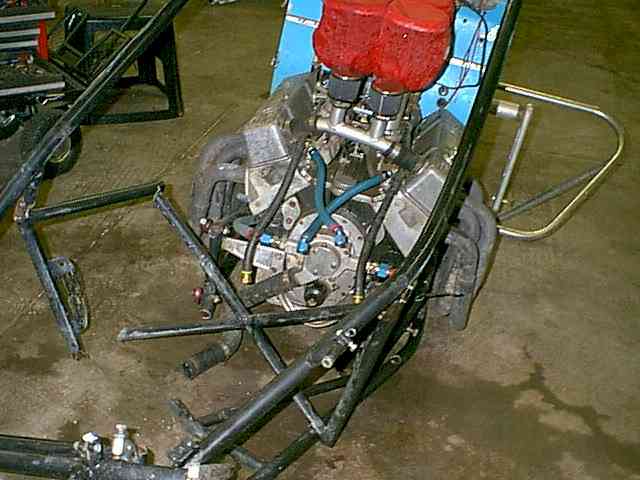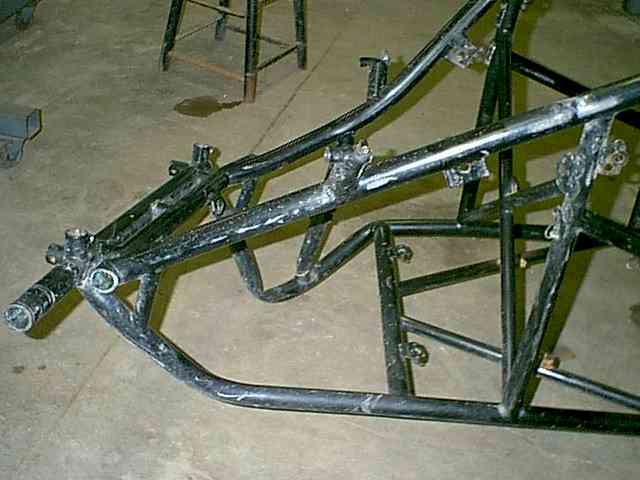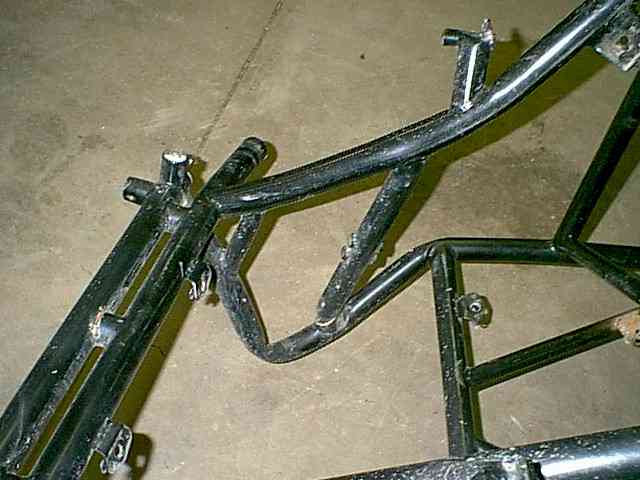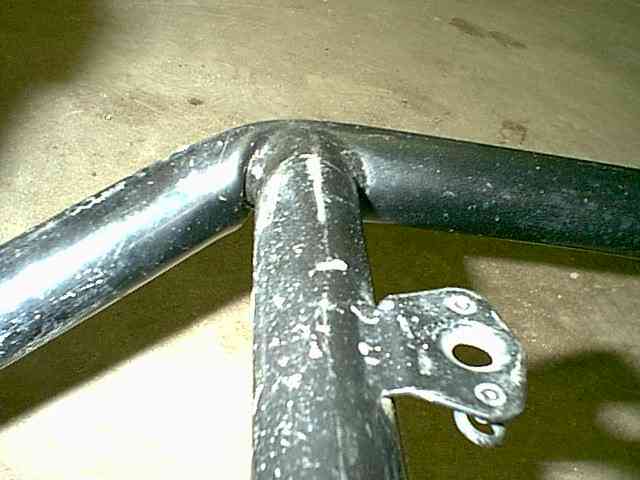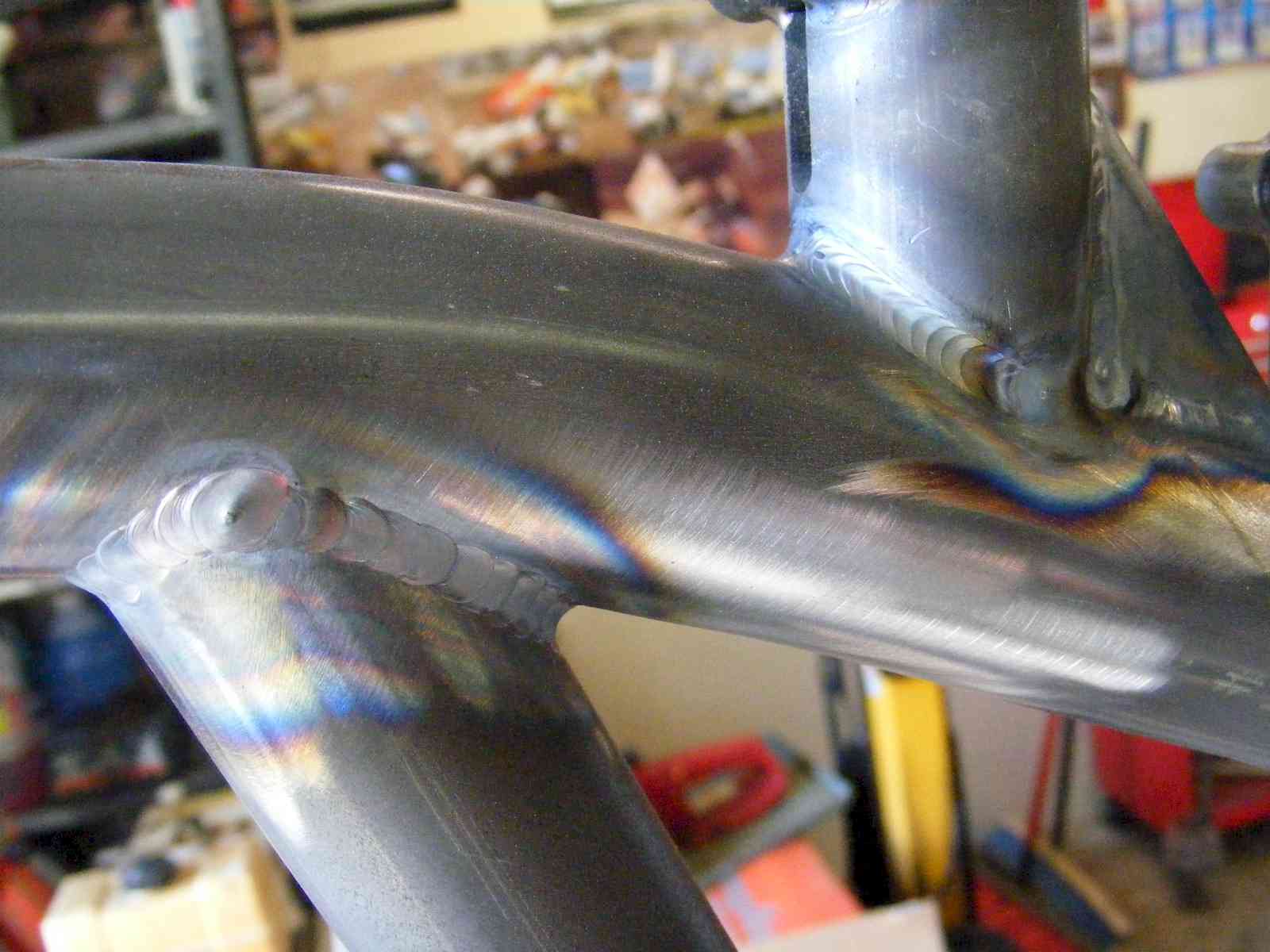
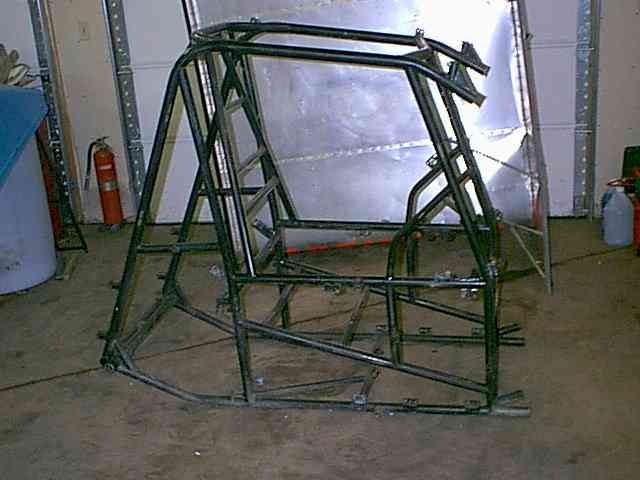
Above - New Maxim. Front upright to top of cage and wing post pocket.
THE MAXIM DISASTER
The thing I hate about an argument is that it
always interrupts a discussion.
G. K. Chesterton (1874 - 1936)
This is an update to my
experience with Maxim chassis. The original disaster story follows below.
Back when I originally wrote the Maxim Disaster piece I was pretty disgusted with the
chassis I had and the owner of the Maxim company (I don’t think he will change, but I
think the product has). Since then, I have struggled with my J&J cars and
we have been getting worse and worse as I have tried to get better. In June of
2010, I ordered a new Maxim frame.
With the J&J cars, I tried new bars, different bar combinations, dyno’d my shocks so I knew what they really were, got new top of the line shocks, changed motor heights and did any other set up thing I could think of that would make the car stick better mid corner. And I may have been making it stick to good and didn’t know it. It could be that I have had my car so tight all along, that in trying to get it to turn, I was breaking it loose. With the car now feeling loose, I instinctively worked on making it tighter which just made things worse. I’m suspecting that has been my main problem all along.
However, my continued frustration led me to change the final active suspension component again… the frame. Even though I got a new J&J frame two years ago in 2008, and it seemed a little better at first, over time things got worse. I could never find a setup that really felt good.
The Maxims have been successful in our series and I had my suspicions that they were somehow different so I decided to make the change.
The new Maxim frame was built to
order for me from their options sheet and shipped to me directly from the factory.
After my last experience with a Maxim chassis, my biggest concern was about
the quality of the welding.
Above - New Maxim. Front upright to top of cage and wing post pocket.
When it arrived, I was pleased to see that the welding looked very good. All joints were sanded before welding, the welds were uniform width, even beading, proper radius, no undercuts and no globs. I was very happy with the appearance.
The next thing I did was weigh the bare frame. The Maxim weighed about 10 pounds less than the J&J.
These two frames sat side by side and were tube for tube the same. There was nothing in one that was not in the other. The J&J was an inch longer, torsion tube to torsion tube but the Maxim was a tall cage that extended 3 inches at the back above the J&J. The fact that the Maxim is lighter (and the other Maxim I had was also lighter than a J&J) may be, what makes a difference in the chassis.
To make the chassis lighter but have all the same tubing means that some tubing must be thinner wall or smaller diameter. The main frame rails and cage are .095 as indicated in the mill stampings on the bare metal. Some of the small diagonals were .049. My guess is that the Maxim has more flex to it due to the thinner walled support tubing.
From a safety stand point, the last Maxim broke apart at the welds on impact, instead of bending and kinking. When the frame bends and kinks, it absorbs energy and spreads out the impact forces over time. When things become disconnected, they can no longer support the structure, allowing other members to be loaded in unintended ways. That allows other places to break and it can be a real problem if that is happening to the roll cage.
Thinner tubing will “give” more and probably allows more crush which should make the car safer, as long as the welds stay together. The down side is that the frame gets bent more and in more places and this happens with lighter impacts.
The last Maxim, hit the RF corner really hard and it Z’d the frame front to back. So, I understand the pluses and minuses and I can accept that the chassis is more vulnerable to damage in a crash. As long as the welds don’t break, I won’t complain and I hope I don’t have to do that test.
When I got the Maxim car together, using all the same running gear from the J&J, and raced it, I liked the way that it felt. There was a difference. I could get on the throttle earlier, mid corner. I didn’t have the feeling that I was sliding across the turn. This car is a shorter (86) wheelbase than the J&J and it carried the front end really easy at corner exit. I could feel the effect of small adjustments. It easily turned in and rolled the corner well and had good transfer and bite coming out. The handling was an improvement in every way I could feel.
The interesting thing about the feel of this chassis is that it was the same running gear that I had in the new J&J (now 20 some races old) and an older J&J frame that we raced after parking the new J&J and now the Maxim. And I got to feel all three frames within a month or so. The older J&J was an improvement over the new J&J but the Maxim worked the best.
It could be that I set up a little looser or maybe it’s is the frame, but at this point, I’ve decided to get another Maxim for the backup car (and I will specify that they use the same welder).
And now, The Original Maxim Disaster Story....
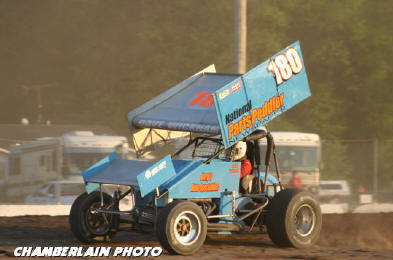 We
picked up this Maxim chassis in the fall of 2004. It was a 3 year old car, like
new, straight and had no damage. It came from the owner of the Petty Driving
Experience and had been sitting idle for 2 years after only a dozen races with USCS in
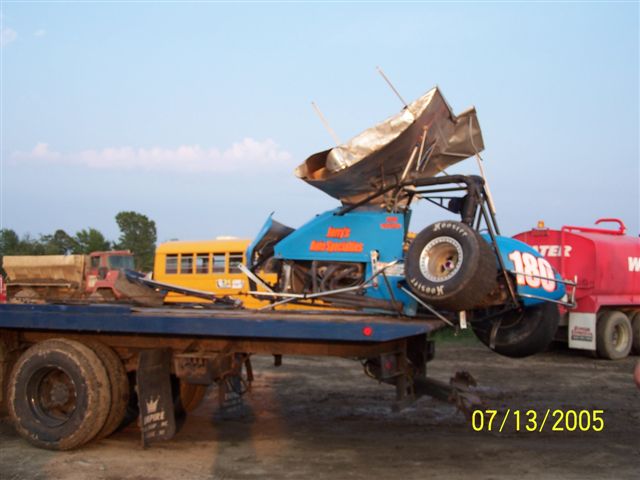
GA. It was mid July when I took a high flying ride, 25 ft in the air at
the start of a heat. The maxim came down hard on the LF corner and continued bouncing off
the tires and landing right side up. Although all the bolt on stuff was torn loose, most
all of the major parts were in tack. The front axle was straight, the rear was ok, the
wing was flattened but the wing supports were not bent. The car looked like junk but most
of the damage was to the radius rods, torsion arms, heims, nerfs, a couple of wheels and
the frame.
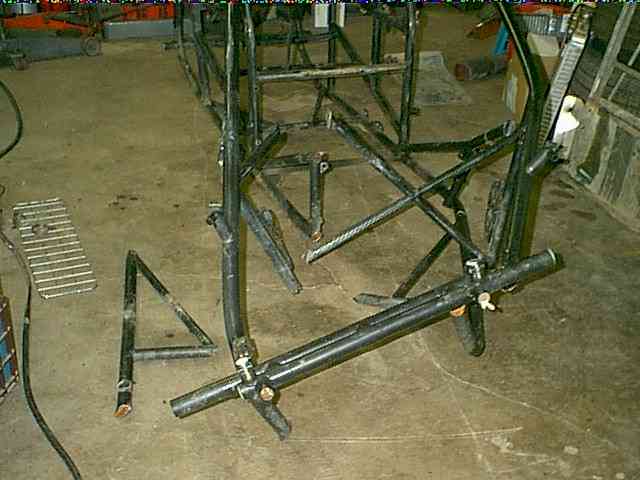
It was not unexpected that the frame was damaged, what was unexpected was the type of damage that I found. This frame shattered where it was impacted. There are fourteen breaks in or near the weld between the front of the motor and the torsion tubes. The connecting tubing is bowed to the right but not kinked. In all of my experience, the weld should be stronger than the tubing and when frames are crashed, the tubing bends until it kinks. In all the cases of crashed sprint car frames that I've seen, the frame stays in tact and the impact causes bending and folding or it was considered abnormal. I'm not so concerned that the front came apart but what does that say about what would happen if the hit had been on the the cage? |
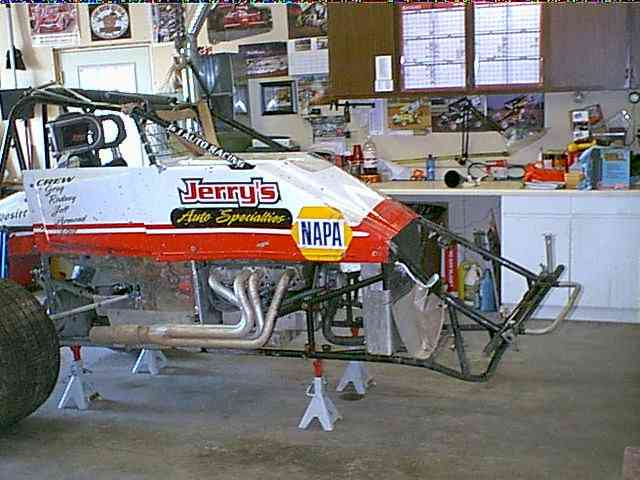 This is the J&J car we got after the maxim disaster. A hard crash at Black Rock in 2006 impacted the RF corner and bent up the front end. The J&J car did what was expected. Tubing kinked and bent but stayed together retaining the strength of the structure. One piece tore near the weld where the tubing was twisted and in tension. All other damage was bends or kinks, no cracks or broken welds... The way it should be.
Tubing kinked, instead of breaking next to the weld. |
|
From my experience and understanding, this type of failure is not proper or acceptable. Six of the 14 breaks were in the weld and the other eight were less than an inch of the weld. The tubing all around the joints is not bent. In fact two pieces were completely broken out at both ends and the pieces of tubing that were ripped out was not bent, even though they were being pulled or pushed in the middle of their length! |
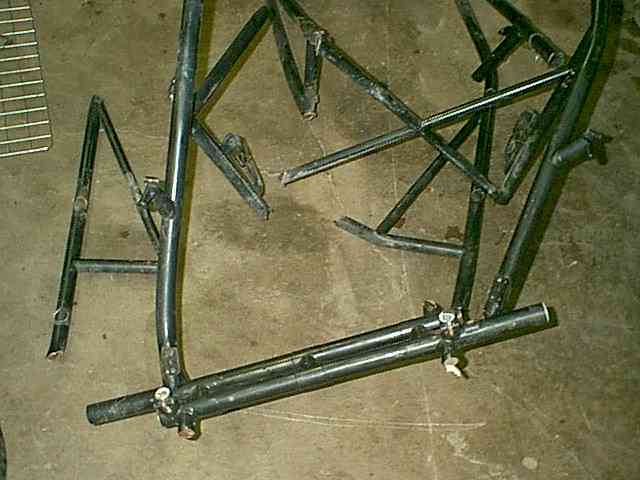
The x in front of the radiator was completely straight but both right side ends were
pulled out
of the right side upright. The lower left of the X is partly torn from the upright
but the upright
weld broke loose before the X was ripped all the way out.
The piece on the floor on the left is the lower frame rail from the right side motor mount
upright to the sway bar upright.
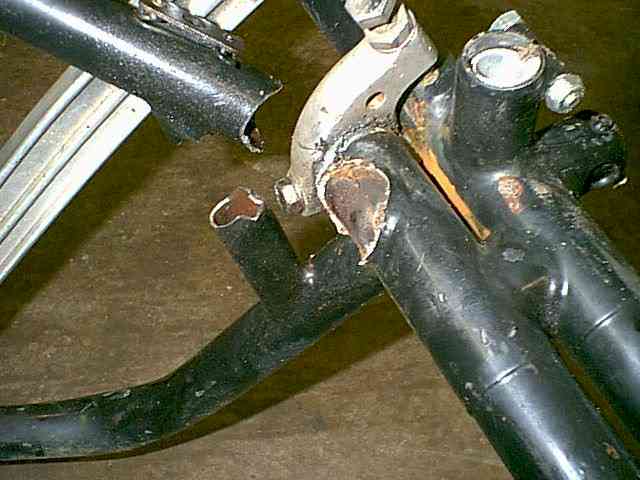
Here you see the LF front torsion tubes and the break in the weld at the end of the down
tube.
The left lower frame rail broke just below the weld to the torsion tube and the gusset
tube
broke at the down tube. The only thing that connected the front torsion tubes to the
rest of
the car was the right side downtube. All other connections were broken.
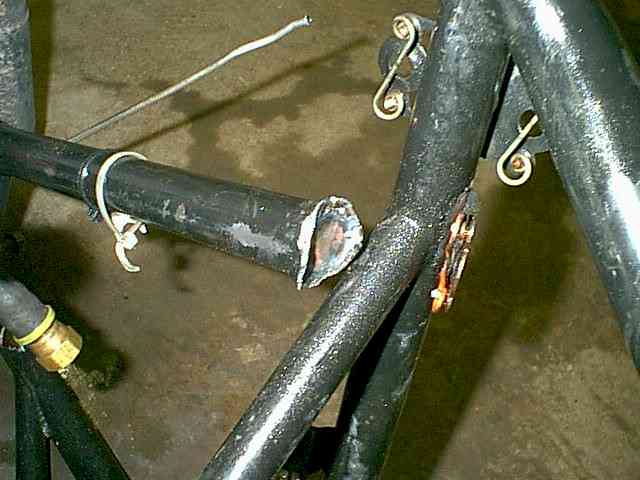
This is the end of the x-brace in front of the radiator where it pulled out of the right
upright.
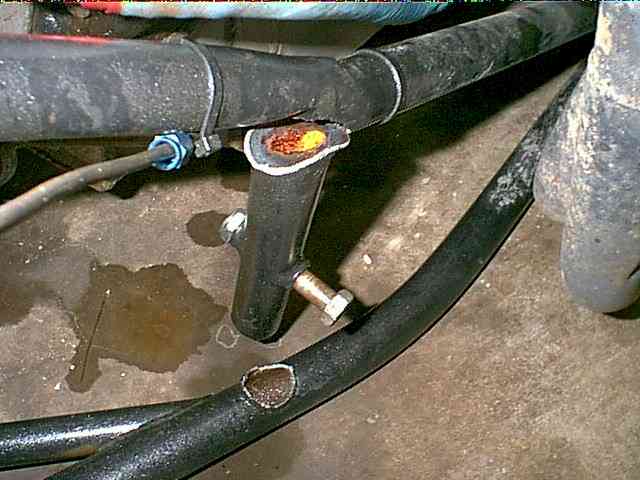
This is the left side upright where the LF front motor plate connects and the LF radius
rod.
The piece of tubing is straight as new but the top is torn out and the bottom is broken at
the weld.
There is a little wrinkling in the upper diagonal where the diagonal was twisted.
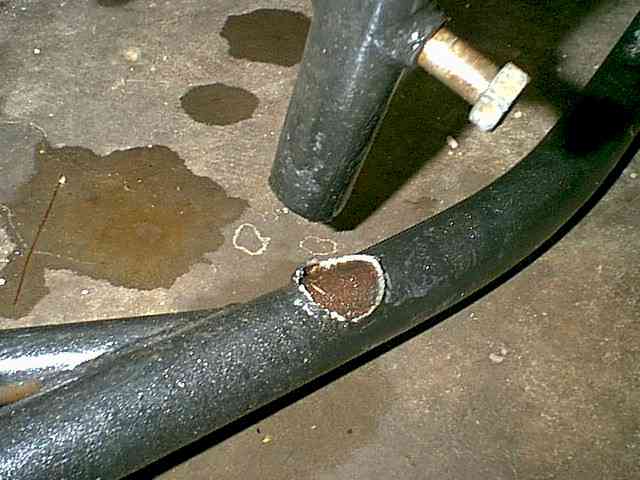
Below...This is the broken weld on the left side motor mount tube from above.
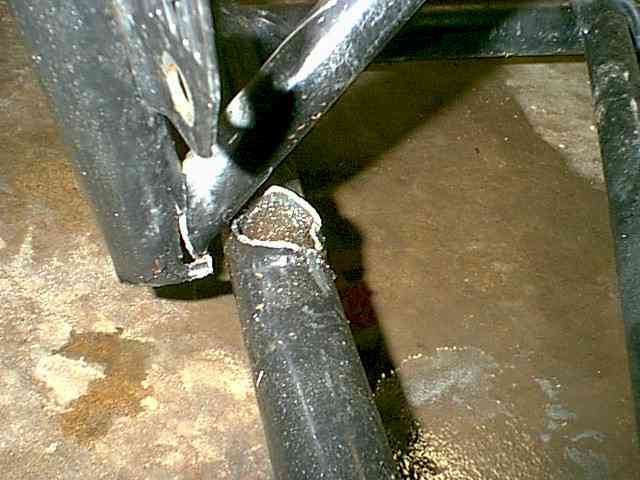
This is where the X-brace in front of the radiator connects to the right side upright and
lower
frame rail.
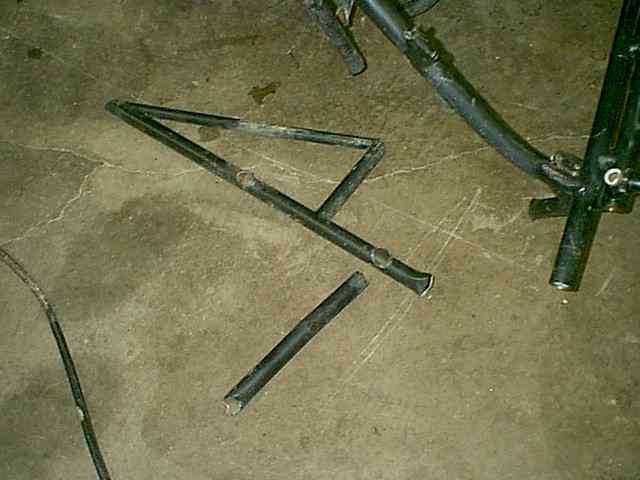
This shows the only intact connection to the front torsion tubes, the lower frame rail
(triangular piece)
and the single piece is the sway bar upright. There is no dent in the tube (not hit
by the axle). It
broke out of the frame at the welds and was connected to the front axle by the aluminum
sway bar
and its aluminum heims. The sway bar was straight, threads were ok too, so it
looks like this tube
was yanked out when the axle hit on it's RF end and was pushed through the chassis.
The sway bar bolt is in the middle of this tube. The tube should have bent in the
middle if
the welds were at least as strong as the tube.
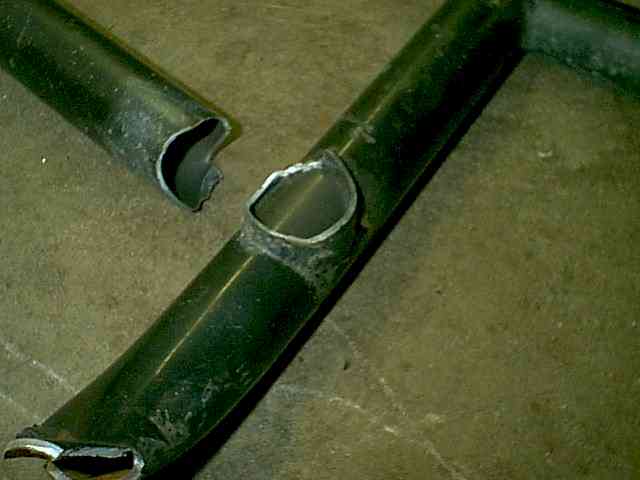
Sway bar upright to lower frame tube broken next to weld.
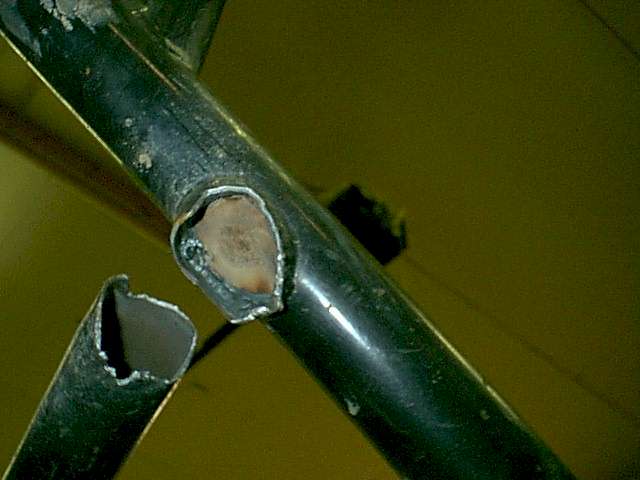
To me it looks like the tubing is brittle and weakened, at or near
the point of welding.
Another possibility is that in some places the tubing wall thickness is so thin that it
isn't strong enough to resist tearing. The Maxim chassis was 11 lbs lighter (6%) than an
identical J&J that replaced it.
It seems logical to me that a tube that was being forced sideways to
its welded joint should either kink the joint INTO the other tube or bend and kink itself.
With kinked or bent tubing, there is still connected strength within the structure.
There is no reason to believe that the rest of the frame is any
different from the front end so I beleive that a hit on the cage would likely have broken
the cage in the same way. It would probably take a bigger hit to break the cage because
there is more large diameter support tubing, but if one piece breaks, it will free that
area to move and pull on the rest of the cage in leveraged and unexpected ways as
succeeding impact forces are applied.
Additionally, once tubing breaks, the danger of injury is increased as the
disconnected tubing becomes a club or spear.
I don't know why this car broke up like it did, but there is something different in this frame from any crashed frame I have seen before (maybe I haven't seen enough crashed Maxims). Was this an aberration (defective frame) or do all Maxims fail this way? The welding is always the first thing blamed and Maxim's welding on this car is not pretty. The filler is piled on instead of having a smooth blended radius between joined tubes. Although Maxim had the welds from broken pieces inspected by an outside firm and they determined that the welds were OK for penetration, undercut, etc., there is something different that occurred to the surrounding tubing. It may be something as simple as too much heat, too slow travel, too much filler, stingy argon gas flow..., you tell me.
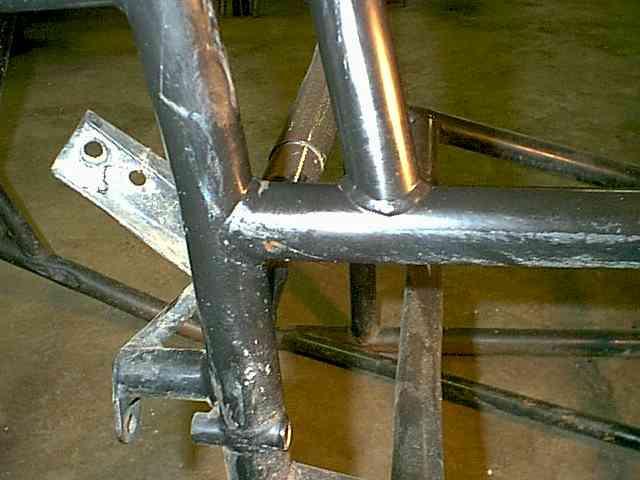
This is the glob style of welding on the Maxim Chassis. In the center of the photo
is the vertical
tube (right side) that holds the seat back mounting and goes to the top of the cage.
All of the welds on the car are build ups like this.
It almost looks like MIG instead of TIG welding.
Below is the same tube (left side) on the J&J car. The welds here have a blended
radius and
even beading. They are smooth and look like examples of proper welding in manuals on
welding
and aircraft construction.
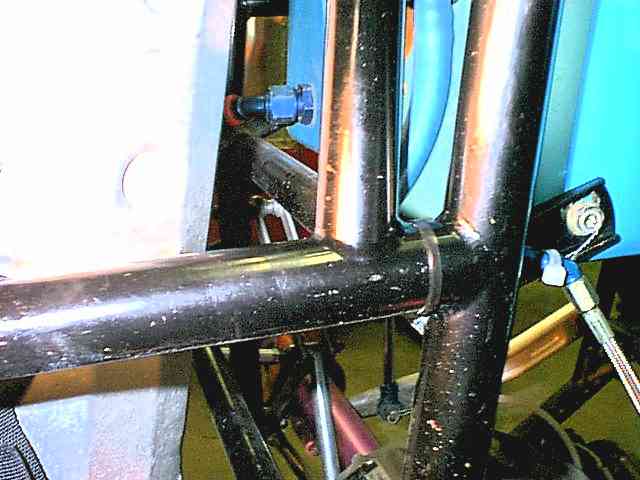
With Maxim's reported high turn over of welders, at best some will
be better than others, but in any case they will all be different. In Maxim's
defense, they say that all welders are certified and drug tested, but that doesn't address
all issues. It appears that any real investigation of their quality won't be done until
after some major catastrophe or high profile fatality occurs (hopefully that will
not happen).
I contacted Maxim about what I saw as a serious problem. At first they seemed concerned,
had a couple of tests tone by an outside company and eventually got reports back that the
welds and the tubing were acceptable. Mike at Maxim had been very professional about
working with me to find an answer and I was hoping that the company would benefit with an
improved product. Maxim clearly did not want to admit to any
fault. BUT when I pressed Maxim for a reason why the frame broke at or near
the welds and tubing didn't bend or kink, I got this "up yours" response from
the owner of Maxim.
From: RaceMaxim at aol.com
To: dave1w at a-znet.com
Sent: Monday, December 05, 2005 11:37 PM
Subject: Re: Frame breaks. FROM CHUCK MERRILL
Hello Dave: I think Mike has gone out Maxim's way to answer any legitimate questions you
have had about an older race car that probably was abused and welded on by God only knows
who and how many times. It may have even been clipped on the front end or somewhere else
by some back yard welder who thinks he is an expert. I appreciate your concern in this
matter but we have done all we can do to answer your questions. We have no reason to
pursue this matter any further. The roll cage did its job and you are here to tell about
it. Best Regards, Chuck Merrill
Unfortunately for Chuck, the frame was clearly a factory pure Maxim from end to end as had been established with Mike at the outset. And fortunately the rollcage was not impacted in the crash (wing posts were not even bent). If they really cared about their product quality and improvement, they would have had this frame shipped back to them for investigation. Maybe they've seen lots of broken frames like this and they don't care or know any better.
So as I see it, this shattering looks to be a problem with something in the Maxim fabrication process but they have no interest in finding out what happened and how to prevent it. My crashed frame has been permanently retired. Maxim is no longer on my Christmas list.
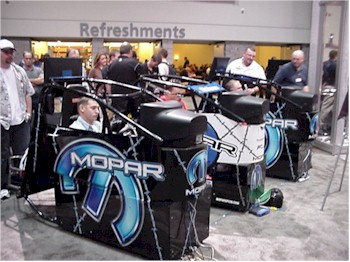
The remaining frame, from the motor back, will make a great racing simulator for realistic computer driving games.
 |
 Best use for a Maxim ;-) |